Walks the valley566 reviews
12 hMt Cook & Hooker Valley Day Tour
★ 4.8 · 566 reviews
- Twelve hours, to Aoraki/Mt Cook National Park
- Small-group journey
- New Zealand’s Southern Alps
- Free cancellation
$152$12.67 / hour
Check availability→ Graded honestly
The tracks at Aoraki run from a boardwalk a pushchair can manage to a route the Department of Conservation says needs mountaineering experience — and both start from the same car park. Getting the Mount Cook hike difficulty right is the difference between a good afternoon and a bad one. Here is every track with its real length, time and elevation, and an honest word about who each one suits.
Quick answer
The short answer. Hooker Valley is easy: 10 km return, about 100 metres of climb, three hours. Kea Point is easier still at 2 km. Tasman Glacier View is 15 minutes of steps. Sealy Tarns is hard — 2,200 steps and 600 metres up. Mueller Hut above it is not a walk at all.
Every track, graded
Distances and times are DOC’s published figures. The grading is ours, and it is the one we would give a friend.
500 metres one way and about five minutes on the flat from the Tasman Valley car park. Anyone who can walk can do it, and it makes a point about glacier retreat in ten minutes flat.
Two kilometres return, about an hour, gently undulating. It ends at a lookout over the Mueller Glacier moraine. This is the one to do if the weather is closing in or you have an hour before dinner.
Three hundred-plus steps and about fifteen minutes up. Short, but continuous and exposed to the wind. Anyone comfortable with two flights of stairs will be fine.
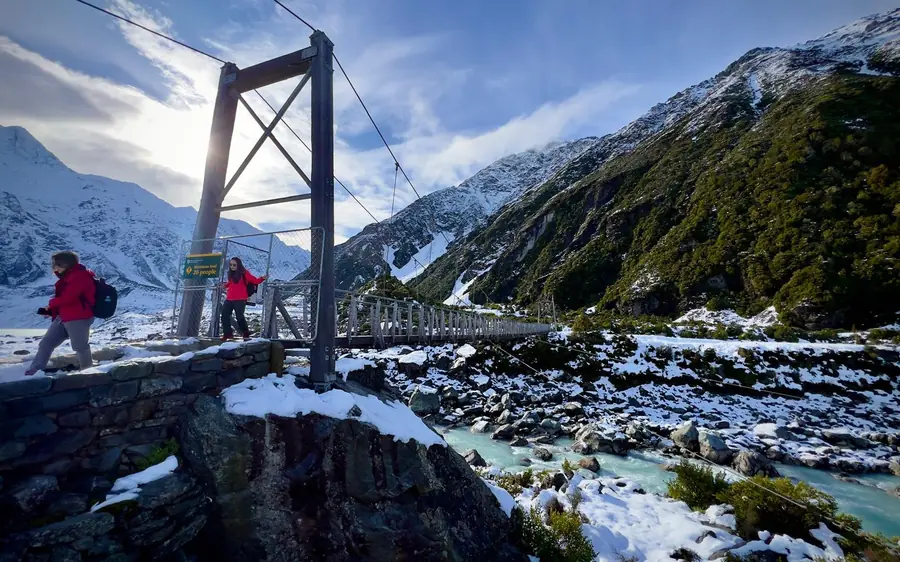
Ten kilometres return over about three hours, with roughly a hundred metres of climb across the whole thing. Formed track and boardwalk, three swing bridges. The distance is the only demand it makes.
2,200 steps and six hundred metres of climb, and DOC warns the track is very steep and narrows near the tarns. Half a day. No technical difficulty and no exposure — it is purely a fitness question, and the descent is harder on knees than the ascent is on lungs.
Above Sealy Tarns the marked steps end. DOC says the route needs mountaineering experience and can hold snow and ice from March to November. Treat it as alpine, not as a longer walk.
The variables
The grades above are for a fine summer day. In July, add one to every line.
Season. Every track here goes up a grade in winter. DOC specifically recommends microspikes and poles for the Hooker Valley, and the reason is counterintuitive: the flat shaded sections are the icy ones, not the climbs.
Wind. The valleys funnel the nor’wester and it arrives with almost no warning. It does not make a track harder to walk so much as harder to enjoy, and on the swing bridges it is what people remember.
Distance from shelter. The Hooker Valley has none for five kilometres and Sealy Tarns has none at all. DOC’s advice on the latter is explicit: if you see weather building from the north-west, turn back.
What you are carrying. Two litres of water is a meaningful weight on 2,200 steps and a non-negotiable one, because there is no water on any of these tracks.
The winter version of all of this is a different page, and worth reading before you book flights.
Walking here in winter→Book direct
A guided valley day, the glacier walk, and the flight that asks nothing of your legs.
★ 4.8 · 566 reviews
★ 4.9 · 322 reviews

★ 4.7 · 514 reviews
Common questions
Easy. Ten kilometres return with about a hundred metres of climb, on formed track and boardwalk. DOC describes it as walkable across a wide range of fitness. The distance is the only real demand, and there is no climbing or exposure anywhere on it.
About ninety minutes each way by DOC’s timings, or roughly three hours return with stops. The three segments are 15 minutes, 30 minutes and 45 minutes.
Sealy Tarns, at 2,200 steps and 600 metres of climb — and it is still a walk. Above it, the Mueller Hut route needs mountaineering experience and is not comparable.
Hooker Valley gains about a hundred metres over five kilometres. Kea Point is close to flat. Sealy Tarns gains six hundred metres. Those three numbers cover almost every day walk in the park.
Yes, easily in summer — it is flat, formed and short enough. In winter it is a different proposition because the shaded sections ice over and DOC recommends microspikes.
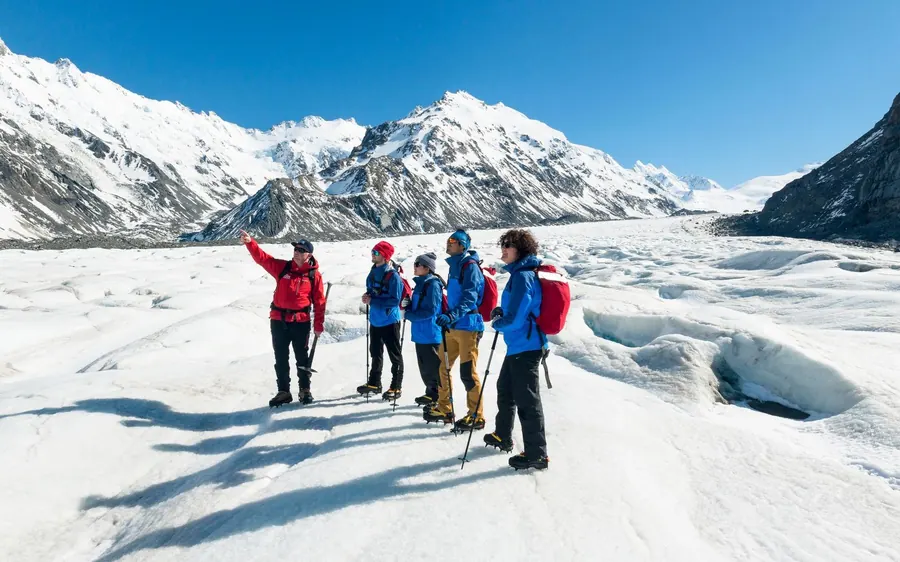
Different rather than harder. About ninety minutes on uneven ice in crampons, with no climbing and no ropes. Physically it sits between the Hooker Valley and Sealy Tarns, and the unfamiliar part is the crampons rather than the effort.
Go deeper
Six marked tracks from the village, with real DOC times and distances.
On the iceThe only walk on the longest glacier in New Zealand, and what the three hours contain.
The famous oneTen kilometres return, three swing bridges, a lake full of icebergs, and it is free.
The hard one2,200 steps and 600 metres of climb, and where the walking stops and mountaineering starts.
The free view300 steps to a viewpoint over a lake that did not exist in 1970.
PricesThree heli hikes priced against the flights and against the walks that cost nothing.
3-Hour Tasman Glacier Heli Hike
★ 4.9 · 646 reviews · Free cancellation 24 h